The distribution comb of the heating system — its purpose, principle of operation, and connection rules
The distribution comb is an important component of a heating system. Its purpose is to distribute the heat carrier (usually water) evenly to each radiator or heat-emitting element. Without a distribution comb, the heat distribution in the system may be uneven, with some radiators receiving more heat than others.
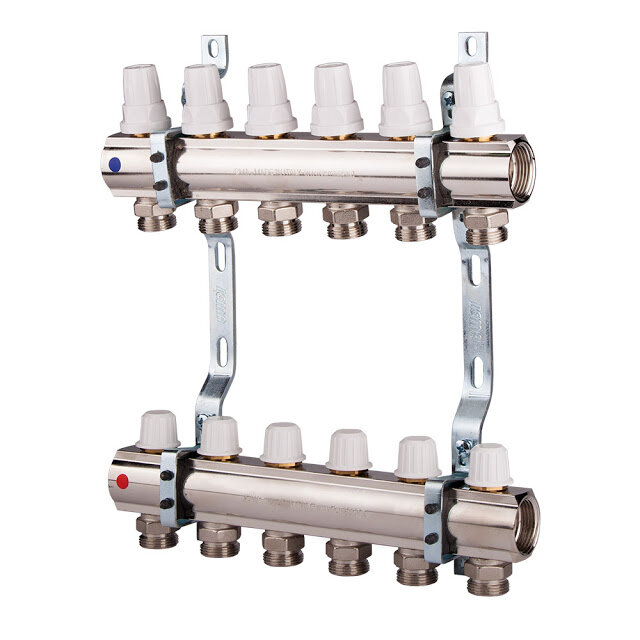
A distribution comb is a collector with a number of outlets, also known as branches or rays. Each outlet is connected to a radiator, and the flow of the heat carrier is regulated by a valve and a thermostatic head. The distribution comb allows for a more efficient and uniform heating of the premises, as each radiator can be individually adjusted to the desired temperature.
The principle of operation of the distribution comb is simple. The heat carrier enters the distribution comb through one end and flows through the outlets to the radiators. As the heat is emitted by the radiators, the cooled heat carrier returns to the comb through the return manifold. This cycle ensures that each radiator receives the necessary amount of heat and that the system operates efficiently.
When connecting the distribution comb, it is important to follow certain rules. The comb should be installed in an easily accessible location, preferably in a separate cabinet or on a wall. The branches of the comb should be connected to the radiators using pipes of the appropriate diameter. The pipes should be insulated to prevent heat loss, especially in areas with low temperatures.
The distribution comb can be connected to the heating system in two ways: as a separate collector or as a part of a collector. The choice depends on the type of heating system and the layout of the premises. In any case, the installation of a distribution comb requires careful planning and calculation of the heat load of each radiator.
In conclusion, the distribution comb is an essential component of a heating system, providing efficient heat distribution and individual temperature control for each radiator. Its installation and connection should be done according to the rules and guidelines to ensure smooth and trouble-free operation.
Purpose of the distribution comb
The distribution comb is an essential element in heating systems that allows for the efficient distribution of heat throughout the area. Its construction consists of a comb-like structure with branches that connect to the radiator pipes.
The principle of operation of the distribution comb is based on the ability to distribute the heat evenly in different parts of the room. The comb acts as a collector, allowing for the connection of multiple radiator pipes to one central point. This method of connection is called a «manifold.»
One of the main advantages of using a distribution comb is that it allows for the individual adjustment of the temperature in each room. By installing valves on each branch of the comb, it is possible to control the flow of hot water to the radiators and regulate the temperature in the room.
Another benefit of using a distribution comb is its ability to accommodate additional rooms or areas in the heating system. If more radiators need to be connected, new branches can be added to the comb, making it a flexible and expandable solution.
Installing a distribution comb is a straightforward process. It is usually placed in a central location, such as a utility room or basement, and connected to the main heating supply and return pipes. From there, the radiator pipes or loops are connected to the comb’s branches.
In systems with circulation pumps, the distribution comb can be used as a hydraulic separator. This means that it separates the hydraulic circuit of the heating system from the temperature control circuit, allowing the system to operate more efficiently.
In conclusion, the distribution comb is an essential component in heating systems, allowing for the effective distribution of heat throughout the area. Its construction and principle of operation make it a useful and versatile tool in both small and large-scale heating systems.
Design of Different Types of Distribution Comb
The distribution comb is an important component in a heating system, used to distribute heat from the boiler to various points in a building. It is a collector-like structure that allows for efficient and controlled distribution of the heat carrier, usually water, to different branches of the heating system.
There are two main types of distribution combs — collector and manifold comb. Each type has its own unique design and is used in specific applications.
The collector comb is the most common type and is used in larger heating systems. It consists of a central collector, which is connected to the boiler, and multiple branches that distribute the heat carrier to different parts of the building. The collector comb can be equipped with flow meters, valves, temperature sensors, and other control elements to regulate the flow and temperature of the heat carrier at each branch point.
The manifold comb, on the other hand, is used in smaller heating systems. It is a compact unit that combines the functions of a collector and a distribution comb. It consists of a manifold with multiple outlets, each connected to a separate heating circuit. The manifold comb is easier to install and requires fewer connections compared to the collector comb.
Regardless of the type, the construction of a distribution comb typically includes the following components:
- Collector or manifold: The main structure that receives the heat carrier from the boiler and distributes it to different branches.
- Branches: Ducts or pipes that carry the heat carrier from the distribution comb to various heating points in the building.
- Valves: Used to regulate the flow and temperature of the heat carrier at each branch point.
- Temperature sensors: Measure the temperature of the heat carrier and provide feedback for controlling the heating system.
- Seals: Gaskets or seals that ensure proper sealing and prevent leaks at connection points.
The distribution comb is an essential component in a heating system as it allows for effective control and distribution of heat. The choice of the comb type depends on the size and complexity of the heating system, as well as the specific requirements of the building. It is important to follow the manufacturer’s guidelines and installation rules when connecting and installing the distribution comb.
In conclusion, the construction of different types of distribution combs may vary, but they all serve the purpose of efficiently distributing heat in a heating system. The collector comb is typically used in larger systems, while the manifold comb is more suitable for smaller systems. Regardless of the type, proper installation and adherence to guidelines are crucial for the effective and safe operation of the heating system.
Principle of Operation of a Distribution Manifold
A distribution manifold, also known as a distribution comb, is an essential component of a heating system. Its main purpose is to distribute hot water from the boiler to different points of heat consumption in an efficient and controlled manner.
The construction of a distribution manifold typically consists of a manifold body with several outlets, called teeth or combs, which are connected to the heating pipes. Each tooth represents a separate circuit that supplies hot water to a specific zone or room in the building. The number of teeth can vary depending on the system’s requirements, but it usually ranges from 2 to 12.
The distribution manifold allows for individual control and regulation of the water flow and temperature in each circuit. It is equipped with valves and flow meters to adjust the water flow rate and monitor the heat consumption. Some advanced models can even be integrated with electronic controllers and sensors to provide precise temperature control and energy-saving features.
One of the main advantages of using a distribution manifold is its ability to ensure an equal distribution of heat throughout the heating system. By adjusting the flow rate and opening or closing valves, it is possible to balance the heat supply among different circuits and achieve a comfortable and uniform temperature in each room.
The distribution manifold is typically installed near the boiler or heat source and connected to the supply and return pipes. It can be installed vertically or horizontally, depending on the specific requirements of the heating system. Proper sealing and insulation are important during installation to prevent heat loss and ensure the efficient operation of the manifold.
In conclusion, the distribution manifold plays a crucial role in the heating system by providing efficient and controlled distribution of hot water. Its construction and features allow for individual control of each circuit, ensuring an even distribution of heat and optimal energy consumption in the building.
Calculation of the flow capacity of the manifolds

The flow capacity of the manifolds is an important factor in the design and installation of a radiant heating system. It determines the amount of heat that can be distributed to each room in an efficient and effective manner.
Manifolds are the central component of a radiant heating system. They serve the purpose of distributing the heat from the boiler to the various rooms of the building. The manifolds are typically installed in a dedicated cabinet, which houses the assembled equipment required for the distribution of the heat, such as valves, thermostatic heads, and fittings.
The flow capacity of the manifolds is calculated based on the size and layout of the system, as well as the desired temperature and the amount of heat required in each room. The calculation takes into account factors such as the length and diameter of the distribution pipes, the number and type of heating elements (such as radiators or underfloor heating), and the temperature differential between the supply and return pipes.
There are different types of manifolds available for radiant heating systems. The most common type is the «louvered manifold,» which consists of a series of individual outlets, called «fingers.» The flow capacity of each finger can be adjusted using flow control valves, allowing for precise distribution of heat to each room. Another type is the «distribution block manifold,» which features a single outlet with multiple branches for distributing the heat.
To ensure an efficient and effective distribution of heat, it is important to size the manifolds correctly. If the flow capacity of the manifolds is too low, the rooms farthest from the manifold may not receive enough heat, leading to cold spots and inefficient heating. On the other hand, if the flow capacity is too high, there may be excess heat in some rooms, while others remain colder.
The flow capacity of the manifolds can be calculated using specialized software or formulas provided by the manufacturer. The calculation takes into account factors such as the length and diameter of the pipes, the number and type of heating elements, and the required temperature differential. It is also important to consider the flow resistance of various components, such as valves, fittings, and seals.
In conclusion, the calculation of the flow capacity of the manifolds is a crucial step in the design and installation of a radiant heating system. It ensures that each room receives the required amount of heat, while minimizing energy consumption and optimizing comfort. By properly sizing the manifolds and taking into account the various factors, such as pipe length, diameter, and flow resistance, a well-designed radiant heating system can provide efficient and effective heating to any building.
Connection rules and installation features
When installing a distribution comb in a heating system, there are several important rules that need to be followed to ensure proper operation. Here are some guidelines for connecting and installing a distribution comb:
- Each radiator in the room should be connected to the distribution comb separately. This can be done by using individual pipes that connect to each radiator.
- The distribution comb should be connected to the supply and return pipes of the heating system. The supply pipe brings hot water from the boiler, while the return pipe carries the cooled water back to the boiler.
- The distribution comb should be equipped with a flow meter or flow indicators to measure and adjust the flow rate of water to each radiator. This helps to ensure that each radiator receives the necessary amount of heat.
- The distribution comb should also have a shut-off valve for each radiator, which allows for individual control and adjustment of the heat output in each room.
- Thermostatic radiator valves (TRVs) can be installed on each radiator to regulate the temperature and control the heat output.
- The distribution comb should be installed in a convenient and accessible location, such as in a utility room or basement.
- It is important to properly size the distribution comb based on the number of radiators and the total heat output of the system. This ensures that the distribution comb can handle the required flow rates and pressures.
- The pipes used for connecting the radiators to the distribution comb should be sized correctly to minimize pressure drops and ensure efficient heat distribution.
Following these rules and guidelines will help ensure that the distribution comb is connected and installed correctly, allowing for efficient and effective heating in each room. For more information and visual guidance, there are helpful videos available online that demonstrate the installation process in detail.
Option 1 — without additional pumps and hydrolock
In this variant, the distribution comb of the heating system is used without additional pumps and a hydrolock. This option is suitable for systems where the temperature difference between the supply and return pipes is not too high, and the power of the heating system allows for proper heat distribution without additional assistance.
The distribution comb, also known as a collector, is the central node of the heating system. It consists of several individual branches that distribute the heat to each radiator in the system. Each branch has a valve that regulates the flow of the heating medium. The distribution comb can be installed in a separate cabinet or can be integrated into the boiler room.
In this variant, it is important to know the diameters of the distribution comb and the branch pipes, as well as the power of each radiator in the system. This information is necessary for the correct calculation and adjustment of the heating system.
Without additional pumps and hydrolock, the heat is distributed through the distribution comb purely by gravity. The higher the temperature of the heating medium, the higher the natural circulation of the heat. This variant allows for a more even distribution of the heat between the radiators, as each radiator receives heat according to its power and temperature requirements.
In this variant, it is not necessary to install additional pumps or hydrolock. The heating medium flows through the distribution comb and the branch pipes without any obstacles. This simplifies the installation and maintenance of the heating system, as there are fewer elements that can fail or require maintenance.
However, it is important to note that in this variant, the temperature of the heating medium may be lower in the radiators farthest from the distribution comb. This is due to the natural heat loss along the length of the pipes. Therefore, it is important to consider the layout of the radiators and adjust the valve settings accordingly to ensure that each radiator receives the desired temperature.
Overall, option 1 — without additional pumps and hydrolock — is a useful variant for heating systems with moderate temperature differences and sufficient power. It allows for a more even distribution of heat and simplifies the installation and maintenance of the system.
Variant 2 — with pumps on each branch and a hydraulic arrow
In the context of heating systems, one of the options for the distribution comb is to install pumps on each branch and a hydraulic arrow. This configuration allows for efficient use of electricity and effective distribution of the heat transfer fluid.
The purpose of the distribution comb in a heating system is to distribute the heat evenly to different points of the system. With the pumps installed on each branch, the distribution comb acts as a collector for the radiators and other heating equipment in the system.
The distribution comb is usually made of several individual comb elements connected by seals. Each comb element corresponds to a different branch of the heating system. The hydraulic arrow, or hydro arrow, is a device that helps control the flow of the heat transfer fluid within the system.
When installing the distribution comb, it is important to follow certain rules. The comb elements should be placed in such a way that each branch has its own pump. This ensures that each branch has sufficient flow capacity and prevents imbalance in the system.
The distribution comb should also be installed at a higher point in the system to allow air to be released. This helps prevent air pockets and ensures proper circulation of the heat transfer fluid.
In addition, it is recommended to install flow meters on each branch of the distribution comb. This allows for better control and monitoring of the flow rates in the system. The flow meters can be connected to a control panel or a central monitoring system.
Overall, the use of a distribution comb with pumps on each branch and a hydraulic arrow is an efficient and effective method for distributing heat in a heating system. It allows for precise control of the flow rates and ensures even distribution of heat to different points in the system.
What you need to know about the downsides?
Despite its many advantages, a distributed comb system also has its downsides. Here are some things you need to know:
- The installation of a distributed comb system is more complex and time-consuming compared to traditional radiator-based heating systems. The process involves connecting additional pipes and valves to each radiator, which can be quite labor-intensive.
- Due to the large number of pipes and valves involved, the maintenance and repair of a distributed comb system can be more challenging. Locating and fixing the exact point of failure can be time-consuming and may require professional assistance.
- While a distributed comb system provides more control over each room’s temperature, it also requires careful adjustment and balancing of the valves on each branch of the comb to achieve optimal heat distribution. Improper adjustment can lead to temperature imbalances and reduced overall efficiency.
- The use of a comb system can increase the overall cost of the heating system due to the need for additional components like pipes, valves, and the comb itself. The installation process may also require additional labor and expertise.
- In some cases, the use of a comb system can result in lower water pressure and flow rate, especially in large systems with multiple radiators. This can affect the heating efficiency and comfort levels in certain rooms.
- For optimal performance, it is essential to properly size and design the comb system based on the specific heating requirements of each room. This involves considering factors like room size, insulation, and heat loss. Incorrect sizing or design can result in inadequate or uneven heating.
- While there are various types of comb systems available, not all are suitable for every application. It’s important to consult with a heating professional to determine the most appropriate comb system for your specific needs.
Despite these drawbacks, a properly designed and installed distributed comb system can provide efficient and comfortable heating for your home or building.
Conclusions and Helpful Video on the Topic
In conclusion, the distribution comb of a heating system is an essential component that helps regulate the flow of the heat carrier through the system. It consists of a collector with branches for each radiator, allowing for individual temperature control and efficient energy use.
The main principle of operation for a distribution comb is that the heat carrier, usually water, is pumped from the boiler through the main supply pipe, and then it is divided into branches using the distribution comb. Each branch is equipped with a flow meter and control valves, allowing for precise adjustment of the temperature in each radiator. The heated water then returns to the collector through the return pipe.
The benefits of using a distribution comb in heating systems include:
- Increased energy efficiency: By regulating the temperature in each radiator, the overall energy consumption can be reduced, resulting in lower heating costs.
- Improved comfort: The individual control of temperature in each room allows for personalized comfort settings.
- Easier installation: The use of a distribution comb simplifies the installation process, as it eliminates the need for additional pipes and fittings.
When connecting a distribution comb, it is important to follow the rules and guidelines provided by the manufacturer. Proper placement and sizing of the comb can ensure optimal performance of the heating system.
In summary, a distribution comb is a key component in heating systems that allows for precise temperature control in each radiator. By using flow meters, control valves, and a collector, the distribution comb ensures efficient energy use and improved comfort levels. When installing a distribution comb, it is important to follow the manufacturer’s guidelines for optimal system performance.
For more information and visual demonstrations of distribution comb systems, you can watch the following helpful video:
Видео:
Трехходовой клапан. Устанавливаем правильно.
Трехходовой клапан. Устанавливаем правильно. de Тепло-вода 645.680 visualizaciones hace 7 años 10 minutos y 23 segundos


